
Every year, billions of dollars worth of clothing is returned to online retailers. A mountain of packaging, a logistical nightmare, and a crushing blow to both profits and the planet. Why? Because the digital promise of convenience often collides head-on with the cold reality of ill-fitting garments and buyer's remorse. For too long, the 'try-before-you-buy' experience has been the missing link in e-commerce fashion, leaving consumers guessing and retailers reeling. But what if the fitting room wasn't just physical, but seamlessly digital, perfectly tailored, and powered by an intelligence that understands your unique form better than you do? This isn't science fiction; it's the rapidly accelerating reality of AI virtual try-on, and it's poised to dismantle fashion as we know it.
 A sleek, futuristic digital avatar trying on clothing virtually, showcasing the seamless experience of AI virtual try-on technology in fashion.
The Cost of Uncertainty: Why Traditional Online Fashion Fails
For decades, online shopping has been plagued by a single, fundamental flaw: the inability to physically interact with a product before purchase. In fashion, this translates to a staggering return rate, often between 20-40%, sometimes even higher for specific categories.
In fashion, this translates to a staggering return rate, often between 20-40%, sometimes even higher for specific categories.
Each return isn't just a lost sale; it's a logistical burden, a carbon footprint, and a dent in customer loyalty. Consumers are frustrated by sizing inconsistencies, misleading product images, and the sheer effort of ordering multiple sizes just to send most of them back. Retailers grapple with inventory management, processing costs, and the diminishing trust of a disillusioned customer base. This inefficiency isn't merely an inconvenience; it's an unsustainable model teetering on the edge of obsolescence.
Enter the Matrix: What is AI Virtual Try-On?
At its core, AI virtual try-on leverages artificial intelligence and sometimes augmented reality (AR) to allow users to digitally 'wear' clothing items. Unlike traditional virtual reality (VR), which immerses you in a completely computer-generated world, AR overlays digital content onto your real-world view. In the context of virtual try-on, this means using advanced algorithms to render garments onto a user's live video feed, a photo of themselves, or a sophisticated digital avatar that mirrors their body shape and dimensions.
The goal? To create a hyper-realistic visualization of how a garment will look and fit before a purchase is made. Companies like Style3D AI are pioneering 'clothes changer video AI,' allowing seamless digital try-ons in motion, while others, such as Perplexity AI, focus on photo-based avatars that accurately show how clothes fit on your actual body. This isn't just about superimposing an image; it's about intelligent fabric draping, realistic lighting, and understanding human anatomy to simulate an authentic wearing experience.
 A sleek, futuristic digital avatar trying on clothing virtually, showcasing the seamless experience of AI virtual try-on technology in fashion.
Beyond the Hype: Current Capabilities & Leading Innovators
The current landscape of AI virtual try-on is rich with innovation, moving beyond simple filters to sophisticated simulations. Leading the charge are platforms that offer robust, practical solutions:
- Style3D AI: This comprehensive platform provides an all-in-one design and try-on system, not only boosting consumer engagement and reducing return rates but also enabling designers to preview styles digitally, significantly cutting sample costs and enhancing efficiency. Their 'What Are the Best AI Virtual Try On Clothes Free Platforms?' blog highlights the growing accessibility.
- Perplexity AI: With its new clothes try-on tool, Perplexity utilizes photo-based avatars to provide a highly personalized fit prediction, offering a glimpse into a future where virtual dressing up becomes an addictive part of the shopping journey.
- Google's Global Expansion: Google has been expanding its virtual try-on experience, initially with shoes and now with apps like Doppl. Doppl uses AI to generate videos showing how outfits might look in motion, pushing the boundaries of what virtual try-on can achieve globally.
- Hugging Face Kolors: For the tech-savvy, Kolors Virtual Try On offers a pathway to build your own AI-powered try-on app, democratizing access to this cutting-edge technology.
- DRESSXME & YouCam: Platforms like DRESSXME serve as personal AI stylists, offering an 'endless virtual closet' where users can upload photos to instantly swap clothes for AI-generated outfits. YouCam, on the other hand, prioritizes realism with its 'AI Smart Fit Technology,' meticulously analyzing user images for precise garment rendering.
These advancements signify a pivotal shift. It's no longer just about seeing a digital representation; it's about experiencing a near-perfect simulation of fit, drape, and style, driven by powerful AI.
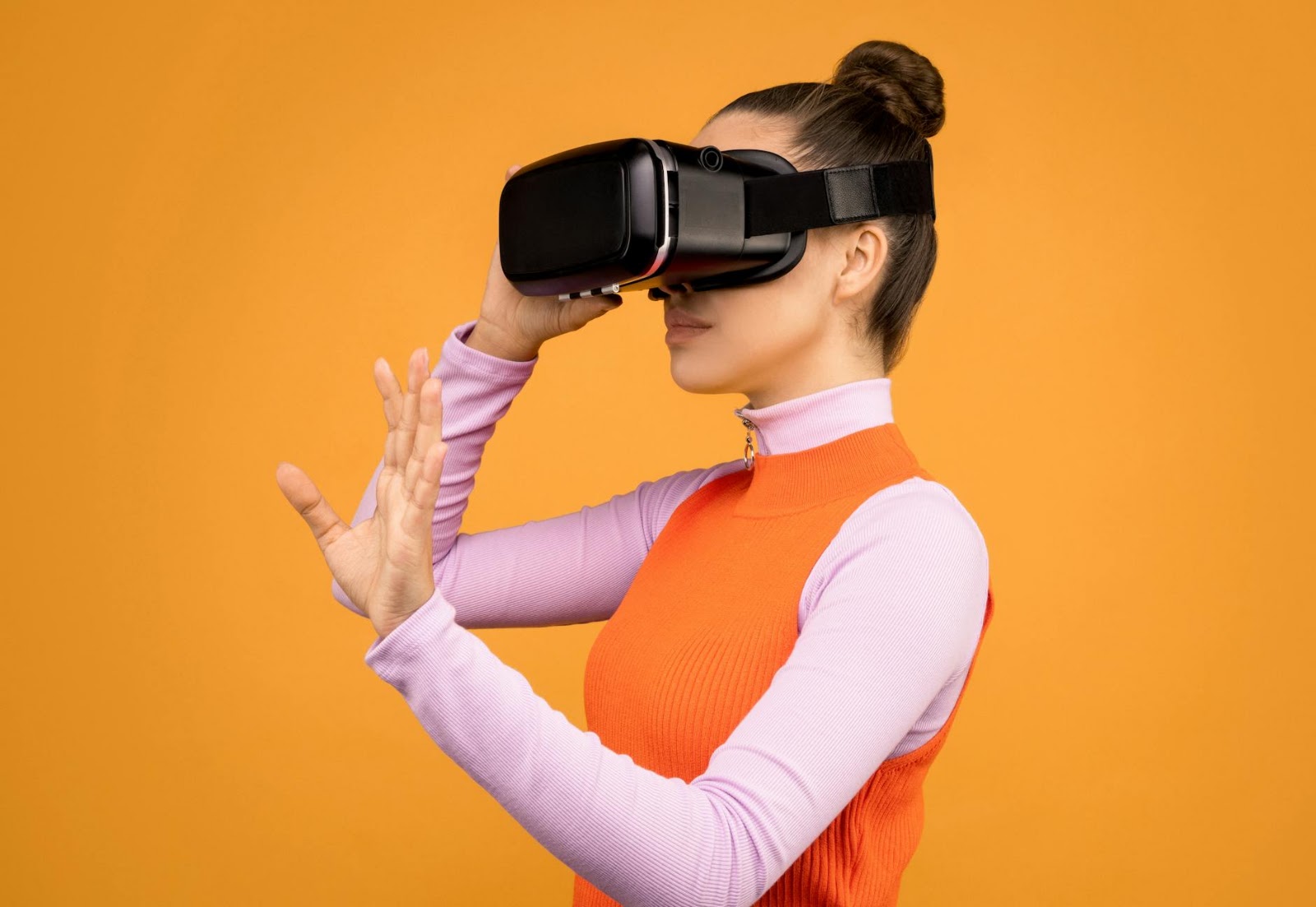 A woman confidently interacting with an augmented reality mirror, trying on a virtual outfit, highlighting the personalized experience of AI virtual try-on.
The Unseen Impact: How VTO Reshapes Industry & Sustainability
The implications of widespread AI virtual try-on extend far beyond individual shopping carts, touching every facet of the fashion industry:
Revolutionizing Consumer Confidence: Shoppers can try on dozens of outfits from the comfort of their homes, experiment with styles they might never consider in-store, and make purchases with unprecedented confidence. This leads to higher satisfaction and, critically, fewer returns.
Boosting Retailer Profitability: Reduced return rates translate directly into significant cost savings for logistics, warehousing, and waste management. Increased confidence also drives higher conversion rates and customer loyalty.
Transforming Fashion Design & Development: Designers can iterate on concepts much faster, visualizing garments on virtual models in real-time. This cuts down on the need for physical samples, dramatically reducing material waste and production timelines, as highlighted by Style3D AI's emphasis on sustainable practices.
Paving the Way for Sustainable Fashion: By minimizing returns and reducing the need for physical prototypes, AI virtual try-on plays a crucial role in lowering the fashion industry's environmental footprint. Less shipping, less waste, and more efficient resource use align perfectly with eco-conscious consumption.
The Ethical Mirror: Challenges, Data, and the Future of Self-Perception
While the benefits are clear, the rapid ascent of AI virtual try-on is not without its complexities. As Jaishree Rajasekaran explored on Medium, we must ask: how close are we to true virtual try-ons? The pursuit of hyper-realism can blur the lines between what's digitally enhanced and what's genuinely achievable, potentially creating unrealistic expectations for consumers. Data privacy is another critical concern; uploading personal photos and body metrics for personalized try-ons raises questions about how this sensitive data is collected, stored, and used. Furthermore, the ability to instantly 'perfect' one's image through AI-generated clothing could have profound psychological impacts on body image and self-perception, especially among younger demographics. Are we moving towards a future where our digital selves are always impeccably dressed, creating a subconscious dissatisfaction with our physical realities? This technology holds immense power, and with it comes a responsibility to ensure ethical development and transparent data practices.
The Final Fitting: Are We Ready for Fashion's Digital Frontier?
AI virtual try-on is not just a trend; it's a fundamental paradigm shift that promises to redefine the relationship between consumers, clothing, and commerce. It offers a powerful antidote to the inefficiencies of traditional online retail, providing unparalleled convenience, reducing environmental impact, and unlocking new creative potential for designers. Yet, as we embrace this frictionless future, we must also critically examine its societal implications. Will it democratize style, making fashion more accessible and personalized, or will it deepen our reliance on digital illusions, creating new challenges for body image and privacy? One thing is certain: the fitting room of tomorrow will look drastically different from yesterday's.
The question isn't if AI virtual try-on will revolutionize fashion, but how profoundly it will reshape our perceptions of self, style, and reality.
The fashion world is at a crossroads, and the digital mirror is about to show us our collective future.
```